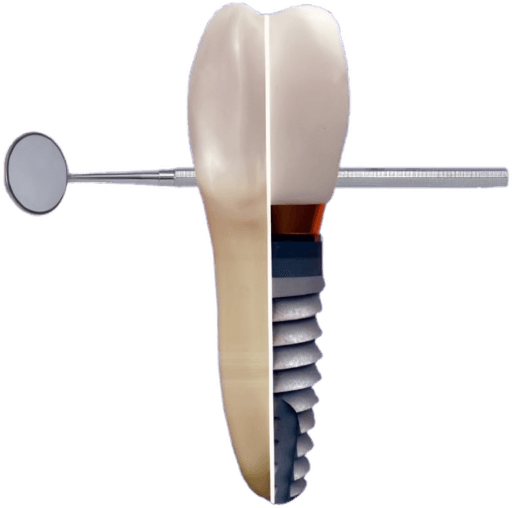
What are dental implants?
A dental implant is a small titanium post that is placed in the jawbone where a tooth is missing. Over a few weeks the bone grows around it and holds it firmly, just like a natural root. A crown that matches your other teeth is then fixed on top.
Because an implant stands on its own, the teeth next to the gap do not need to be cut down, as they would for a traditional bridge. Implants can replace one tooth, several teeth, or support a fixed set of teeth for people who have lost most of them.
Who needs it?
- You have lost one or more teeth to decay, gum disease or an injury
- Your denture feels loose or uncomfortable when you eat
- You want a fixed option instead of a removable plate
- You are in good general health and your gums are healthy (we treat gum problems first if needed)
Watch: dental implants at our clinic
All videosWhat happens when missing teeth are not replaced
A 3D scan shows how, when lost teeth are not replaced, the remaining teeth take the extra load of chewing, wear down and can break. The red circle marks the teeth most likely to fracture next.
About this videoWhy missing teeth can lead to broken teeth
A 37-year-old patient came to the clinic with a broken tooth. His X-ray and 3D scan show how missing teeth that were never replaced put extra pressure on the remaining teeth while eating. Replacing missing teeth protects the teeth you still have. Captions in Marathi.
About this videoAn old dental bridge that failed, seen on a 3D scan
X-rays and a 3D scan of an old dental bridge in the upper jaw and the teeth that supported it, and the bridge after removal.
About this videoDental implant or dental bridge? Two ways to replace a tooth
An animated explainer on the two main fixed ways to replace a missing tooth: a dental bridge, supported by crowns on the neighbouring teeth, and a dental implant, a small titanium post placed in the jawbone. Captions in Marathi.
About this video
How the procedure works
Step 1
Consultation and scan
We examine the area, take an X-ray or scan to check bone height and quality, and explain your options and the full timeline.
Step 2
Implant placement
Under local anaesthetic, the implant is placed in the jaw. Most patients feel pressure rather than pain, and the visit usually takes under an hour for a single implant.
Step 3
Healing period
The bone bonds with the implant over roughly two to four months. You may wear a temporary tooth during this time so there is no visible gap.
Step 4
Crown fitting
Once the implant is stable, we take a measurement and fit a custom crown shaded to match your neighbouring teeth.
Step 5
Review visits
We check the implant, gums and bite at follow-up visits and show you how to clean around it.
Recovery and aftercare
Mild swelling or soreness for two to three days is normal and is managed with the medicines we prescribe. Eat soft food on the other side for the first few days and avoid smoking, which slows healing.
With good brushing, flossing and regular check-ups, a well-placed implant can last for many years.
Frequently asked questions
Is getting a dental implant painful?
The procedure is done under local anaesthetic, so you should not feel pain during it. Afterwards most people describe mild soreness for a couple of days, similar to a tooth extraction.
How long does the whole implant process take?
For most patients it takes about three to five months from placement to the final crown, because the bone needs time to bond with the implant. Your exact timeline depends on your bone and gum health.
Am I too old for dental implants?
Age alone is rarely a barrier. What matters more is your general health, bone support and gum health. We assess this at your consultation.
Can diabetics get dental implants?
Many people with well-controlled diabetes have implants successfully. We will ask about your sugar levels and may coordinate with your physician before treatment.
How do I care for an implant?
Brush twice a day, clean between teeth daily, and keep your regular check-ups. Implants do not decay, but the gum around them still needs care.